TheBrief · Learn With Me
The AI Stack: A Blueprint for Technological Supremacy
The 60 Second Read
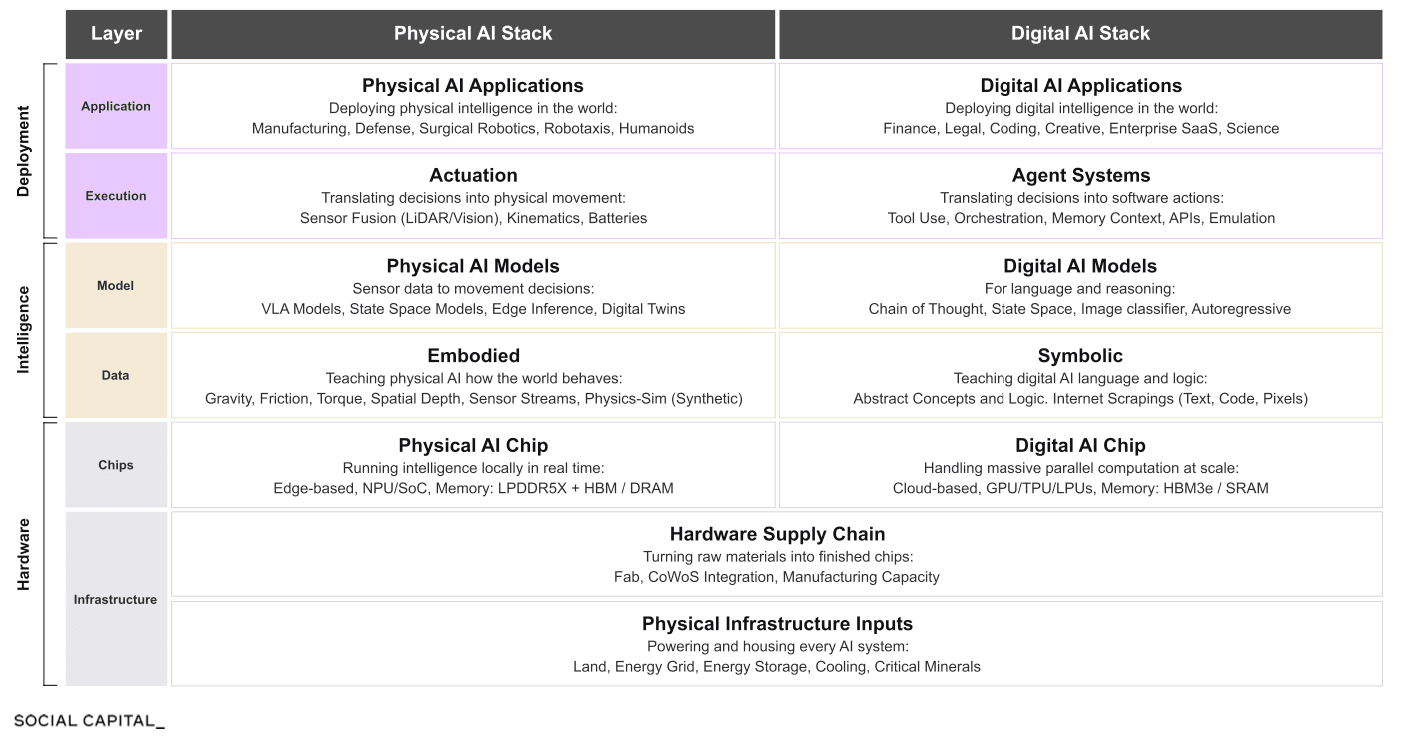
Every general-purpose technology reshuffles the economy, and the winners are rarely the ones drilling the wells. Rockefeller won oil by owning the refining and pipelines every barrel had to pass through; Cisco owned the router every packet crossed. This Deep Dive asks the same question of AI. Which layers are the fulcrum assets, the ones every unit of value must pass through, that cannot be replicated, and that set the terms for everyone above and below? It maps AI as a six-layer stack: infrastructure, chips, data, models, execution, and application. Above silicon, the stack splits into two races: digital AI, predicting tokens in the cloud at massive scale, and physical AI, moving bodies through the world in milliseconds on a battery. The layer everyone watches is commoditizing fastest. Running a GPT-3-class model costs roughly 1,500x less than six years ago, and open-weight models trail the frontier by three to six months. Meanwhile the binding constraint has moved from compute to power, minerals, and skilled labor, bottlenecks that resolve on decade timescales rather than release cycles. Value barbells to the two ends: unavoidable tollbooths at the bottom, and applications that own distribution, data, or authority at the top.
Key Takeaways
- Takeaway 01
Two races after silicon
Digital AI scales by tokens, where ten more agents is an API call, while physical AI scales by atoms and every robot must be built, shipped, powered, and maintained.
- Takeaway 02
The model layer is commoditizing
GPT-3-class inference has fallen roughly 1,500x in price in six years, and open-weight models trail the frontier by 3–6 months. Durable positions sit above the model in applications and agents, or below it in data and chips.
- Takeaway 03
The constraint is now physical
Gas turbines are reservation-locked through 2029, large transformers carry 128-week lead times, and the buildout needs roughly 300,000 new electricians whose apprenticeships take four to five years.
- Takeaway 04
The decade's tollbooths
A handful of unavoidable chokepoints: ASML's EUV optics, TSMC's advanced packaging, Spruce Pine's crucible-grade quartz, Ajinomoto's build-up film, and China's 90-plus percent grip on refined rare earths.
- Takeaway 05
Embodied data is the moat
A deployed fleet generates training data no competitor can buy or scrape: the first mover compounds while the second entrant has to rebuild the loop.
- Takeaway 06
Applications own the revenue
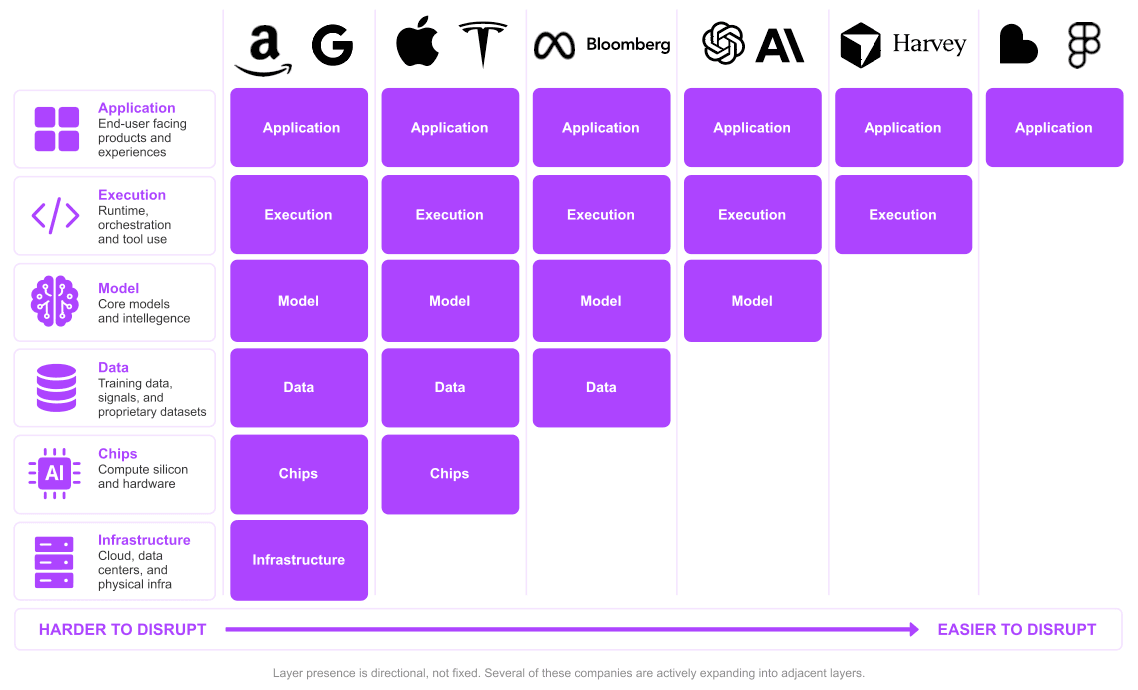
Every layer below is a derivative claim on what the app can charge. Survivors own at least two of distribution, proprietary state, and authority. An app with none is mathematically a prompt, and prompts are fungible.
Why This Matters
The lesson of every platform shift is that the obvious layer is rarely the durable one. Chasing model benchmarks means chasing the fastest-commoditizing asset in the stack; the market has already voted, which is why the gatekeepers below and the demand-owners above capture the returns. The actionable screen is the fulcrum test: does every unit of value pass through you, can you be substituted, and do you set the terms? For the rest of this decade the honest answers live in unglamorous places, in power, refining, packaging, and electricians, and in applications that own distribution or proprietary data. If you are building in physical AI, deployment is the strategy: the fleet is the moat, because embodied data cannot be scraped, bought, or simulated into existence. Patience compounds on hardware cadences in a way capital alone does not.
Featured Charts & Graphs
Chamath’s Take
Chamath’s audio commentary on this Brief is coming soon.