TheBrief · Learn With Me
Privacy Tokens: An Alternative to Public Ledgers
The 60 Second Read
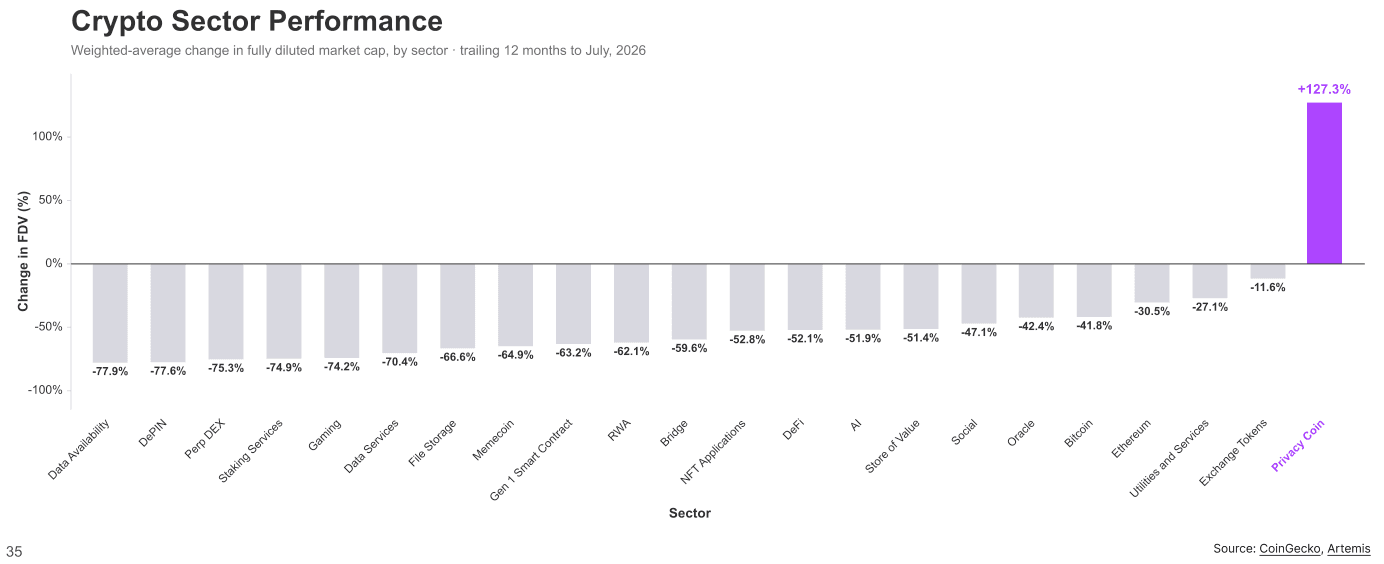
In 1947, the House Un-American Activities Committee subpoenaed donor lists to identify Americans funding civil rights groups and the ACLU; the named were blacklisted, some imprisoned. The demand for financial privacy is ancient, running from bearer instruments and hawala to Swiss secrecy and offshore trusts, and high-net-worth families still pay 0.5–1.5% of assets annually to buy it. Bitcoin inverted the baseline: every transaction lives on a public ledger forever, tainted coins trade at a 10–20% discount, and wrench attacks surged 75% in 2025 to $41M stolen. This Deep Dive maps the tokens that answer with math instead of attorneys. Zero-knowledge proofs, described at MIT in 1985 and practical by 2016, let a network verify a transaction without seeing it. Monero made privacy mandatory and was delisted from every major Western exchange; Zcash made it opt-in with viewing keys and won a $99M Grayscale trust now filed to become the first U.S. spot privacy-coin ETF. Privacy coins returned +127.3% over the trailing year, the only positive crypto sector, even as the EU prepares to ban them for 450 million people in July 2027. The dividing line is auditability: privacy you can prove clean on demand survives; privacy you cannot goes underground.
Key Takeaways
- Takeaway 01
The only green sector in crypto
Privacy coins returned +127.3% in weighted fully diluted market cap in the twelve months to July 2026, while every other sector fell and the next best, exchange tokens, was down 11.6%. The category crossed a $15B+ combined market cap.
- Takeaway 02
Fungibility failure is priced
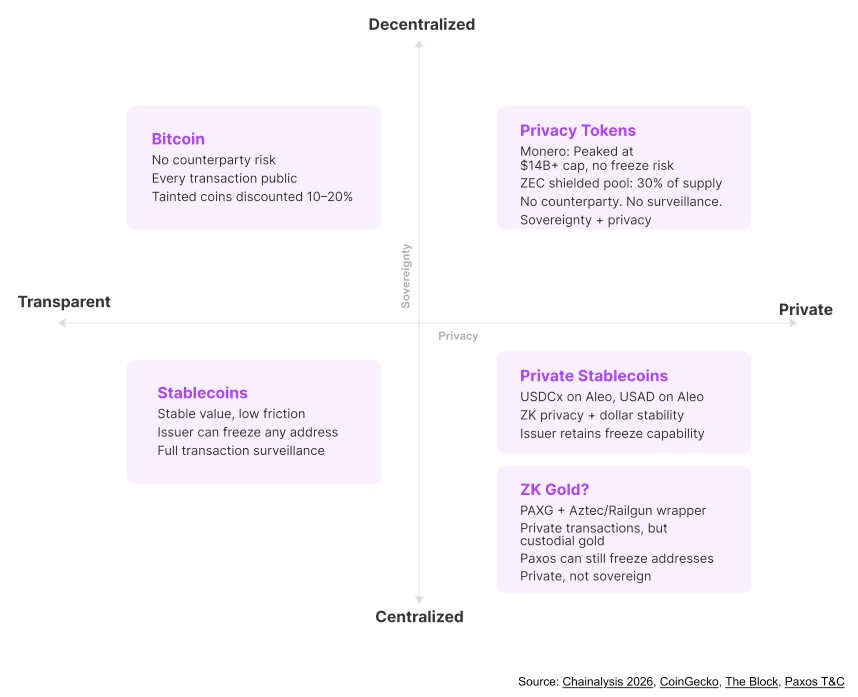
A bitcoin that touched a mixer or sanctioned address trades at a 10–20% OTC discount to an identical clean coin, and visible balances turn holders into targets: wrench attacks rose 75% in 2025 to 72 verified assaults and $40.9M in losses.
- Takeaway 03
Opposite bets, both winning
Monero made privacy mandatory and peaked above a $14B cap despite delisting from most Western-regulated exchanges; Zcash made it opt-in with viewing keys, grew its shielded pool to roughly 30% of supply, and backs a $99M Grayscale trust filed to become the first U.S. spot privacy-coin ETF.
- Takeaway 04
A legal map contradictory by design
The SEC closed its Zcash review in January 2026 with no enforcement recommendation while the same government has funded $1.25M+ in Monero-tracing contracts; the Fifth Circuit ruled OFAC exceeded its authority on Tornado Cash, yet 73 exchanges delisted privacy coins in 2025 and the EU's AMLR bars them across a 450M-person market from July 2027.
- Takeaway 05
Confidentiality's cost is auditability
Bitcoin's 2010 supply bug was caught publicly within five hours; Zcash's Orchard counterfeiting flaw sat live for four years until an AI audit agent found it in 28 hours in May 2026, and because the ledger is shielded, no one can prove it was never exploited. The Ironwood upgrade aims to make shielded supply verifiable.
- Takeaway 06
Compliance optionality is the new axis
Circle's USDCx and Paxos's USAD, private dollar stablecoins on Aleo, went live under the GENIUS Act; Aztec raised ~$119M in venture funding plus a ~$61M token sale for private smart contracts on Ethereum; and selective disclosure, private by default and provable on demand, is the design most likely to reach every buyer pool.
Why This Matters
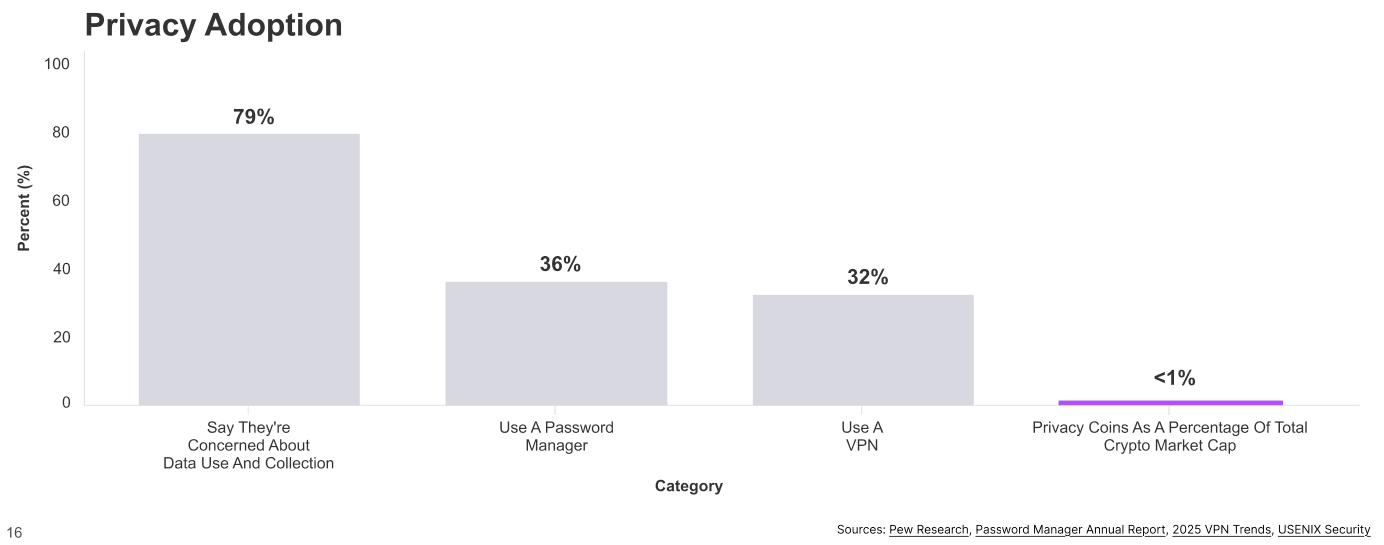
The revealed-preference gap is the tell: 79% of Americans say they care about data privacy, yet privacy coins are under 1% of crypto market cap. Adoption decays with every unit of friction, so the winners will make privacy the default, not the chore. The screen for operators is compliance optionality: mandatory privacy survives only outside the regulated perimeter, while opt-in designs with selective disclosure, private by default and provable to an auditor on demand, can reach all four buyer pools, from early adopters to governments. The most plausible scenario is the split: jurisdictions fracture and privacy tokens become geopolitical instruments as much as trades. The milestones that resolve it are dated: Zcash's Ironwood supply-integrity upgrade, Monero's FCMP++, Ethereum's ERC-7984 draft, and EU AMLR enforcement in July 2027. Watch the infrastructure, not the ideology.
Featured Charts & Graphs
Chamath’s Take
Chamath’s audio commentary on this Brief is coming soon.